
Fleet electrification at scale: What California’s smart charging pilots reveal

This series highlights findings from our Standard Review Projects and AB 1082/1083 Pilots throughout Evaluation Year 2024. This independent evaluation examined 12 active EV charging infrastructure programs and pilots across California, authorized by the California Public Utilities Commission (CPUC) and funded by investor-owned utilities. The analysis draws on the nation’s largest fleet dataset, combining utility data, site visits, charging records, market analysis, and fleet operator surveys. In total, the evaluation covers more than 60% of the state’s class 3–8 electric vehicles.
In our first post in this series, we explored how managed charging helps California’s electric vehicle (EV) fleets ease grid impacts and lower costs. This article builds on those findings and focuses on where smart charging delivers the greatest financial and emissions benefits.
Data-driven insights
In 2024, more than 150 fleets provided sufficient consumption data to model opportunities for improved utility billing and reduced electricity emissions. Our analysis relied on either detailed charging session data or a market-segment modeling approach, dependent on data availability at each site. Together, these methods reflect the diversity of fleet sizes and operating conditions across the state.
Key findings
- Two-thirds of fleet projects demonstrated the potential to reduce annual utility bills by 25% to 45% by optimizing charging.
- On average, fleets could reduce greenhouse gas emissions by approximately 25% by aligning charging with periods when the grid typically has the cleanest electricity.
- Most fleets already have the technical foundation for load management, as nearly all projects use modern hardware and networked software platforms.
The role of load management
Load management enables fleets to shift charging to periods when electricity costs and grid emissions are lower. Fleets that actively applied charging management strategies consistently achieved the lowest operating costs and emissions outcomes in their segments. The results show that when implemented effectively, load management can deliver measurable progress toward both financial and environmental objectives.
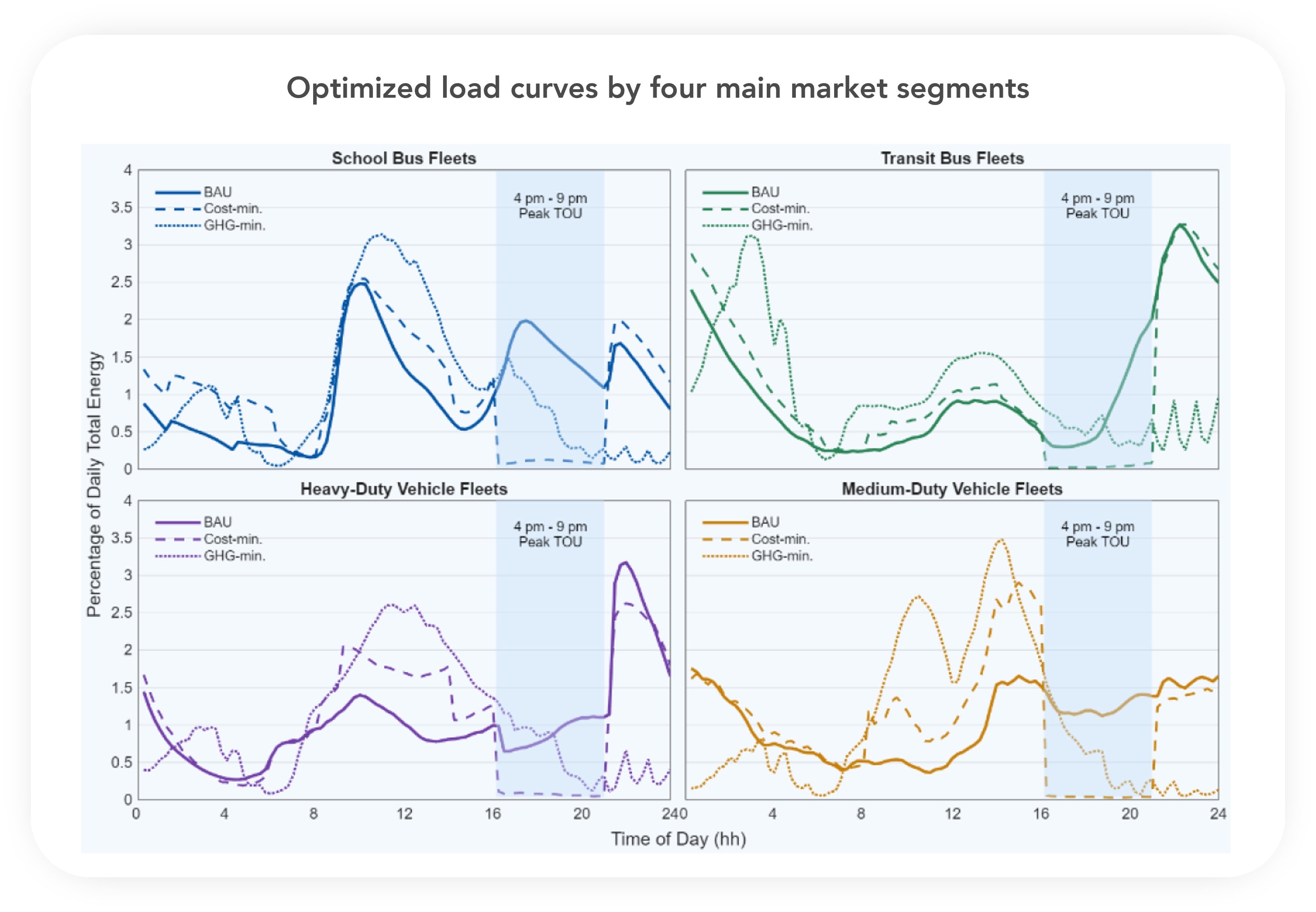
When comparing the “business as usual” charging patterns with optimized scenarios for cost and emissions outcomes, the analysis shows that most fleets could substantially reduce charging during the high-cost 4 p.m. to 9 p.m. time period. This shift is most pronounced for school bus fleets, which have greater flexibility to move charging to midday hours. For fleets with less flexibility, such as heavy-duty trucks or transit buses, strategies like partial charging during peak hours, completing charging later in the evening when rates drop, and using smart charging software to delay non-essential charging can still deliver meaningful savings and emissions reductions.
Across all market segments, reallocating charging from evening peak periods to midday results in lower electricity costs and reduced greenhouse gas emissions.
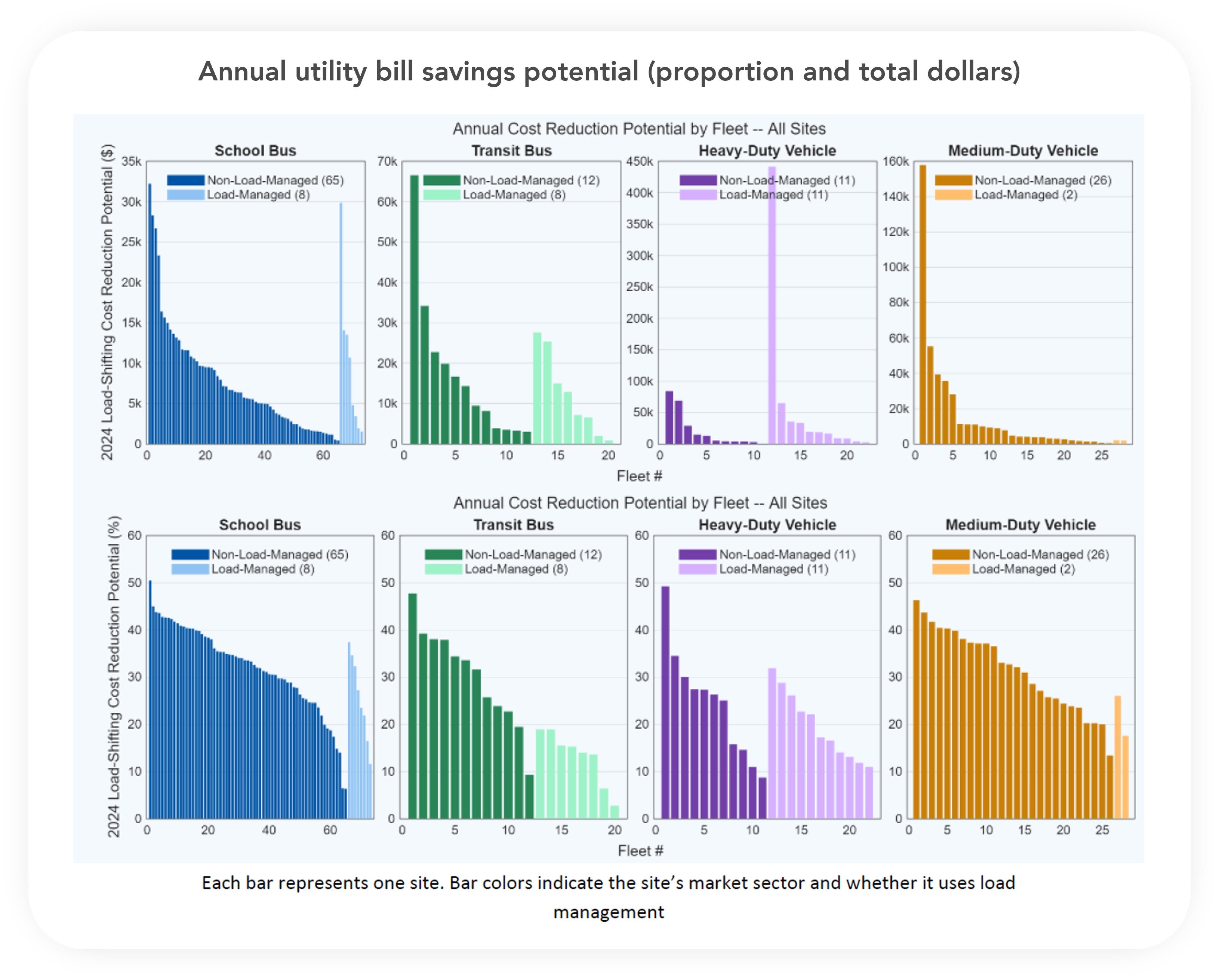
This figure shows the distribution of annual utility bill savings potential by market segment under optimized charging conditions per anonymized fleet. Savings are driven primarily by the extent to which fleets can shift charging away from the 4 p.m. to 9 p.m. peak pricing window. Results suggest most fleets have an opportunity to save 25% to 45% annually for the lifetime of these projects. Achieving this could encourage fleets to apply EVs more broadly to their operations.
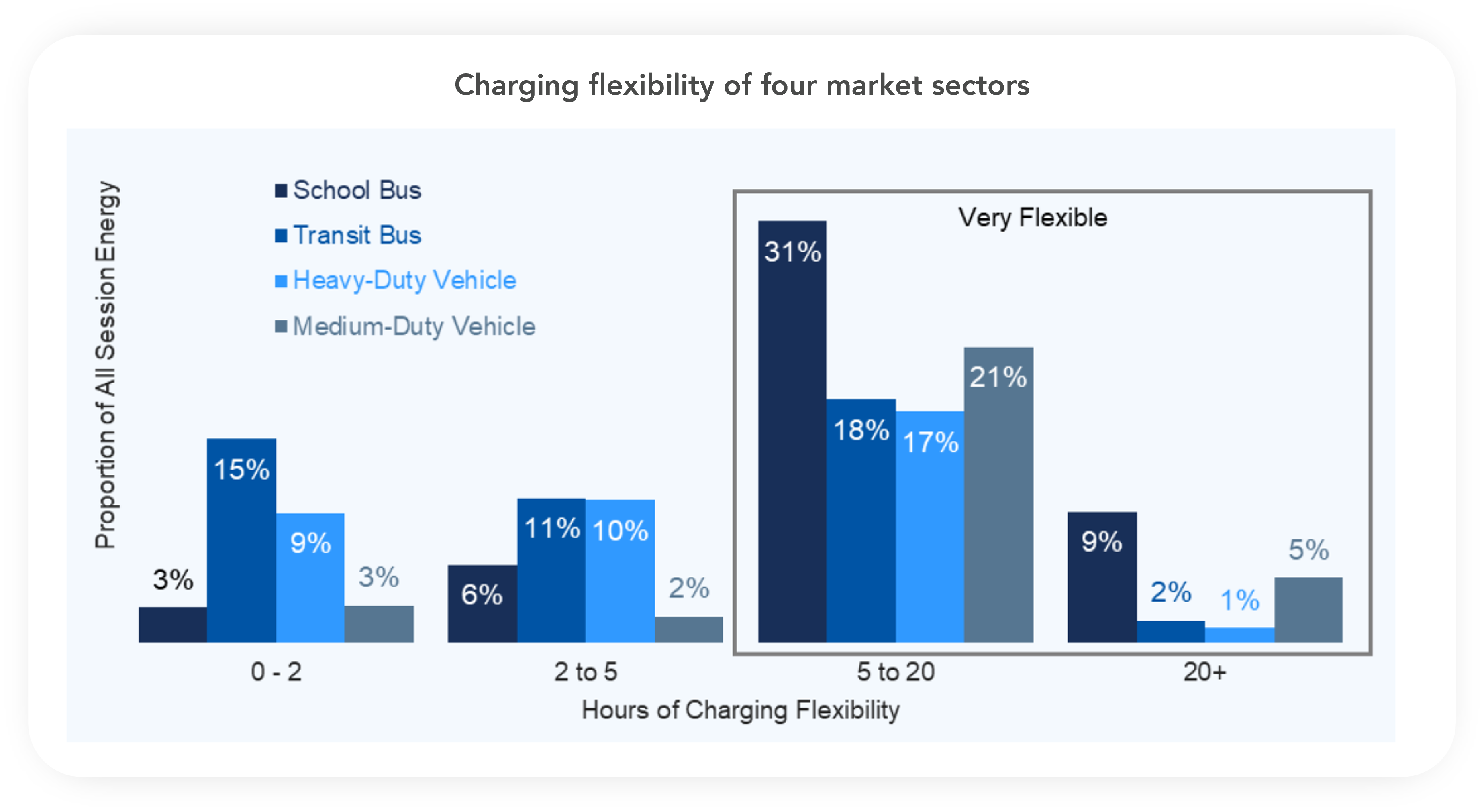
Determining the charging flexibility for individual fleets helps to indicate the extent to which they can adhere to pricing signals. Charging flexibility varies across fleet types, affecting the ability to shift charging away from the highest-cost 4 p.m. to 9 p.m. time period. This analysis measures the duration vehicles are plugged in without actively charging, which indicates the practical opportunity to reschedule charging to lower-cost hours without disrupting fleet operations. For example, a fleet where vehicles are plugged in but not charging from 12 a.m. to 5 a.m. can shift their charging from the higher-cost 4 p.m. to 9 p.m. period to these lower-cost overnight hours.
Results show that several fleet segments, particularly school bus fleets, have substantial flexibility. For example, 49% of all school bus charging sessions overlap with peak hours, but 40% of all charging sessions have enough flexibility to completely charge at lower cost times.
What this means and next steps
The opportunity for fleet operators to achieve energy savings and reduce emissions is real and within reach. Most fleets already have the hardware and software needed to manage charging more effectively, and they have the flexibility to make it happen. Now, it’s about putting these tools to work.
Utilities and program managers can help by supporting education, incentives, and clear guidance on load management and checking in regularly with their customers to ensure everyone is aware of trends in billing and operations while marching toward low-cost energy. Fleets that act now will be best-positioned to cut costs and reduce emissions.
Find out how CLEAResult Energetics can support utilities and fleets through this transition. Follow us on LinkedIn for more findings and highlights from our latest evaluation report.